News
A student’s perspective: immersion & engagement in online learning



Share with colleagues
Download the full Case Study
Take an in-depth look at how educators have used Cadmus to better deliver assessments.
As we well know, government policies around Covid-19 forced a mass transition in education delivery in 2020. On-campus learning was largely paused, and institutions and educators scrambled to shift learning materials and tools of assessment online. As a student who has experienced both on-campus and online study, I would like to offer some insights — some food for thought — for other students, teachers, and anyone tasked with curating the online student experience.
Whenever I think about this, I land on the idea of immersion. By immersion, I mean getting closer to the in-person experience. Through deeper immersion, teachers can connect with and support their students, helping them feel stimulated and less isolated. It is also a chance for teachers to gain a more intimate understanding of how their contributions and efforts are being received. This can ultimately lead to better student well-being and overall success, especially as we navigate the changes from in-person to online learning (Orrell 2020).
“Educators can’t just scan the textbook, record the lesson, put them online and expect the same or better learning.”
Immersion could be improved by connecting teachers and students through more tangible mediums (Text > Audio > Video) and by including more thoughtful synchronous learning touchpoints (Delayed discussion board threads > dedicated group chats > live lectures > live classes with student-student and student-teacher interaction). Similar ideas can also apply to learning materials, where more interactive activities give students a feeling of immersion in the subject content, and offer teachers the chance to add their flavour to it.
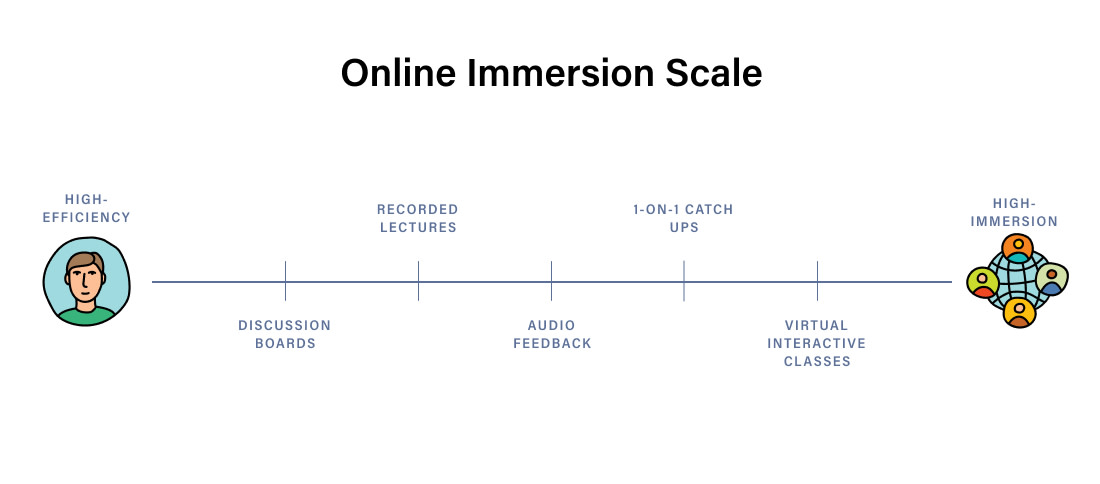
Online Immersion Scale
An important question to ask when comparing in-person and online learning is, just how similar should they be? I’ve come to see online learning experiences on a scale, with different institutions, and even subjects, sitting at different points.
High-Immersion
On one side, if you take the content, structure and timetable of a unit and adapt it to make the most of online delivery, this would be High-Immersion. The abilities of this are not set in stone as EdTech continues to evolve, but for the sake of conceptualisation, this is essentially as close as you can get to recreating the classroom experience online - a virtual replica.
High-Efficiency
On the other side of the scale, is High-Efficiency learning. This is where the learning materials are uploaded, the unit structure is presented, and students are able to go at their own pace, individually, just as long as they get their assessments done on time - there is no timetable. This would mean a reduction in immersive contact between teachers and classmates, but would also provide benefits of efficiency, convenience, and cost-effectiveness. The time-management control afforded to students to schedule their learning around other responsibilities is extremely valuable to us, and a main perk of online learning.
There isn’t a right or wrong position to take along this scale, there are pros and cons to teachers and students on both sides, but somewhere in the middle would bring the benefits of both approaches.
Why Immersion Is Important
Humans are social. We benefit from in-person interactions with each other through body language, impromptu conversations, and their tangents. Through engaging interactions, we learn novel things about our studies and each other. In TEQSA’s Student Perceptions of Online Learning Quality Project, students identified reduced academic interactions and peer socialisation as key concerns to them during Covid-19. This isn’t just sentimental; even core stages of completing a degree (learning the material and passing assessments) are supported greatly by personal connection and immersion. Yet, they can be easily overlooked due to the pressures of trying to optimise online learning.
I had a recent experience that helped to solidify this for myself. I received assignment results through Turnitin, accompanied by text-based feedback from my teacher. What was new to me was an audio file at the bottom. That audio was a 3-minute voice recording from my teacher, reiterating some of his text-based feedback, while also articulating some finer details. This small gesture felt profoundly personal, in contrast to the primarily text-based interactions which have made up my online learning. I made sure to send him a quick email to show my appreciation.
"It felt like I, as a student, was specifically considered by the teacher, which immediately lifted my motivation."
Forging The Future of Learning
Research has shown that even the simple use of video and other interactive resources, can better link teachers with their students, encouraging students to remain engaged and motivated (Ashrafi et al. 2020). The LMS works well to provide raw learning materials and increase the convenience and efficiency of study, but there seems to be a large, intriguing space where new EdTech solutions could be used to deliver innovative and intelligent resources (Song & Luan 2020).
“Teachers need to distill their key goals and leverage technology features to meet them. Used well — online chat, discussion forums, replayable video lessons, online meetings, etc. offer tremendous opportunities to make students more engaged”
Ultimately, teachers love to see their students learning, thriving, and genuinely embracing their content. And students appreciate the effort that goes into building motivation, engagement, and guiding them confidently toward success. By placing a greater focus on immersion in online learning, we can develop creative solutions that reflect the best elements of the in-person experience — effectively connecting teachers and students.
Category
Student Success
More News
Load more


Academic Integrity
Assessment Design
Teaching & Learning
Student Success
From bold ideas to real assessment change: What we heard at the Universities Australia Solutions Summit
Last week in Canberra, the Universities Australia Solutions Summit delivered on its promise of big ideas, bold conversations, and real solutions. These are the themes that stood out—from keynote sessions to candid conversations with university leaders across the Summit.
Cadmus
2026-03-02



Assessment Design
Company
Independent ROI analysis: What the findings mean for Universities
Independent analysis by Nous Group confirms a clear link: stronger assessment design improves student outcomes, strengthens retention, and delivers measurable financial return — with a 7.1x average ROI.
2026-02-18



Assessment Design
Leadership
Teaching & Learning
Secure assessment: From policy to practice
This article examines how Australian universities can translate assessment policy intent into sustainable practice amid growing pressures from generative AI, regulatory expectations, and equity considerations. It advocates a shift from surveillance-driven approaches toward a whole-of-institution, design-led model of academic integrity that balances secure assessment with learner-centred practice and public trust.
Cadmus
2026-02-09