News
Academic integrity with Cadmus



Share with colleagues
Download the full Case Study
Take an in-depth look at how educators have used Cadmus to better deliver assessments.
Academic integrity is “the moral code of academia. It involves using, generating and communicating information in an ethical, honest and responsible manner” (Monash University, 2013). It’s an important part of assessment. Not only is it necessary for protecting and maintaining the standards of your university degree, but it also provides you with an opportunity to learn and develop valuable skills that will serve you in your professional lives. Without academic integrity measures in assessment, the value that students and teachers gain through assessment is diminished.
First and Foremost, Cadmus takes an educative approach to academic integrity
The Cadmus environment includes educative features to help you learn and develop academic writing skills. These features help you identify and follow correct academic practices when copying and pasting content. When pasting a sentence from an external source, Cadmus will add a “Paste Chip” at the end of your pasted text. This tells you how many words have been pasted, and reminds you to add a citation or consider paraphrasing if necessary.
Directly within Cadmus, you can also find a collection of university curated resources and articles — about academic writing and academic integrity. These are found in a feature known as “Cadmus Manual”. You can access Cadmus Manual by hitting the ? in the lower right hand corner, or through Paste Chips directly. You will find articles that teach you strategies and techniques to improve your writing skills, including referencing guides and examples.
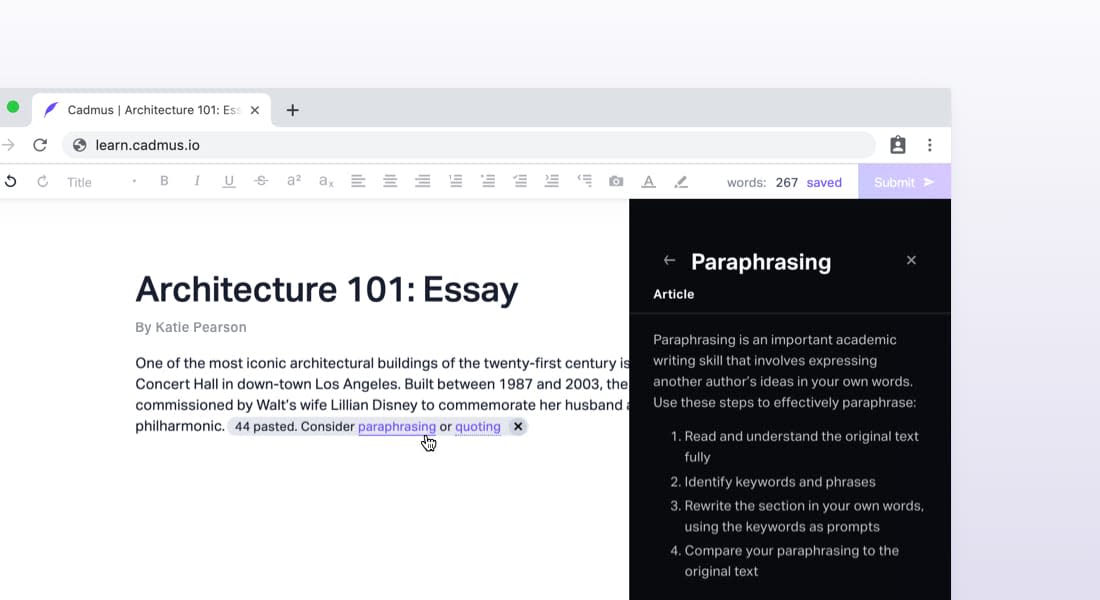
View academic writing tips in Cadmus Manual when you paste in external content
Cadmus assists teachers who are investigating cases of suspected misconduct
Here’s how it works… If your lecturer has concerns about the authenticity of an assignment submitted with Cadmus (e.g. they notice a high Similarity score), they may use Cadmus’ analytics to better understand how the assignment in question was constructed.
These analytics can provide insights such as:
-
How many words were pasted into the document;
-
How much editing was performed before the final submission;
-
How many unique devices were used to complete the work;
-
etc.
With this information, it’s up to your unit coordinator or academic integrity reviewer to reach their own conclusions. A student will also have a right to access any information made available to their unit coordinator or academic integrity reviewer.
Cadmus does NOT flag for plagiarism or indicate whether any form of academic misconduct has taken place. It only provides tools to assist unit coordinators who are already conducting an investigation into potential academic misconduct.
How to avoid potential academic integrity issues, and get the most out of Cadmus
Most academic integrity issues are unintentional or accidental — like forgetting to cite, or replacing words with synonyms rather than correctly paraphrasing. Staying on top of these things in Cadmus is easy. Here are some simple tips:
-
Follow the educative features inside Cadmus (including Paste Chips and Cadmus Manual). They help you avoid potential issues with academic integrity before you submit your final work, and they also teach you how to meet certain academic writing standards. Who knows, they might even help you squeeze an extra mark or two!
-
Try completing all your work inside Cadmus. There are a bunch of features that make planning, researching, note taking and drafting really easy and convenient. However, if you’re the type of student who likes writing notes by hand, that’s OK — Cadmus won’t penalise you for copying this work in.
Category
Teaching & Learning
More News
Load more


Academic Integrity
Assessment Design
Teaching & Learning
Student Success
From bold ideas to real assessment change: What we heard at the Universities Australia Solutions Summit
Last week in Canberra, the Universities Australia Solutions Summit delivered on its promise of big ideas, bold conversations, and real solutions. These are the themes that stood out—from keynote sessions to candid conversations with university leaders across the Summit.
Cadmus
2026-03-02



Assessment Design
Company
Independent ROI analysis: What the findings mean for Universities
Independent analysis by Nous Group confirms a clear link: stronger assessment design improves student outcomes, strengthens retention, and delivers measurable financial return — with a 7.1x average ROI.
2026-02-18



Assessment Design
Leadership
Teaching & Learning
Secure assessment: From policy to practice
This article examines how Australian universities can translate assessment policy intent into sustainable practice amid growing pressures from generative AI, regulatory expectations, and equity considerations. It advocates a shift from surveillance-driven approaches toward a whole-of-institution, design-led model of academic integrity that balances secure assessment with learner-centred practice and public trust.
Cadmus
2026-02-09