News
Attitudes towards assessment: moving away from exams


Share with colleagues
Download the full Case Study
Take an in-depth look at how educators have used Cadmus to better deliver assessments.
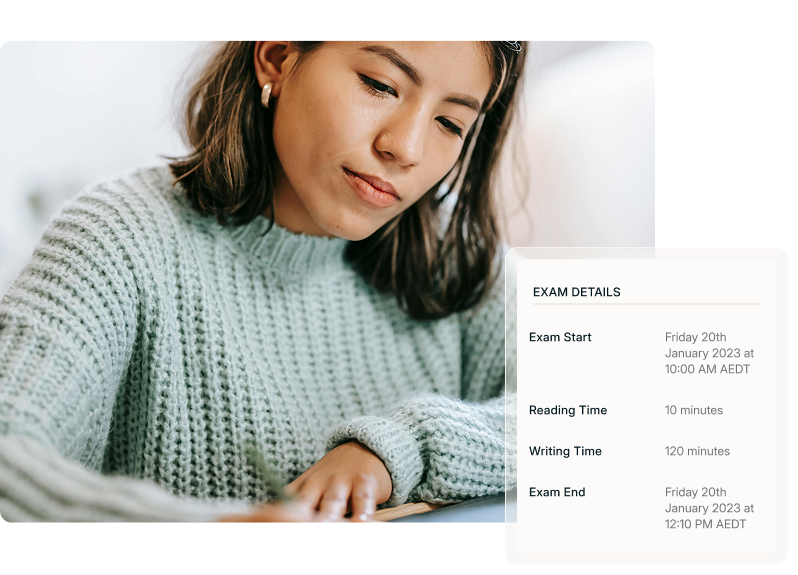
It’s no surprise that the structure of assessments within a course influences student motivation and study habits. From a students point of view, the weightings of assessments are an obvious indicator of what content and skills are truly valued.
Students often work in the opposite direction to what we’d like. They let what’s being assessed define what needs to be learned — not the other way around.
So when we consider how much weighting we place on end-of-semester exams, it’s no wonder we see students disengaging during the semester, and cramming 12 weeks worth of learning into a couple of days and nights. When students orient themselves towards what’s going to be assessed on an exam, it comes at the expense of deeper learning. And while we might try to create exam tasks that encourage more than just remembering and regurgitating, there’s only so much we can fairly ask students to do in a two-hour period.
Authentic assessment over exams
More and more institutions are trying to shift away from high-stakes examinations, and towards creating holistic assessment experiences for their students. By taking students out of an exam hall and removing the limitations of a standard invigilated exam, we have the opportunity to engage students in authentic learning experiences. What’s better, is that authentic assessment pieces provide a more reliable indication of student learning, especially when we want to evaluate higher-order skills. Understanding and analysing concepts, applying knowledge, and thinking critically are a lot easier to assess without the pressures of a standard exam.
While continuous assessment becomes a golden standard for encouraging consistent student learning, we can work towards that goal by adding formative elements to prepare students for traditionally summative tasks. Crafting an assessment journey of research, planning, and drafting, in the build up to a time-limited, final piece is just one example of this. Working feedback into the process means students are able to learn through the assessment as well.
These cumulative assessment experiences also help students feel more confident coming into high stakes assessments. With multiple opportunities to evaluate their knowledge and skills, they build on their understanding while receiving feedback along the way. Providing students with early indicators of their progress lets them fill in the gaps and work towards achieving learning outcomes — all in time for their final assessment. So as we begin to rethink assessment strategies, supporting students along the way, we also see changes in student attitudes towards learning.
Engaging assessment made easy
One of the main motivations for invigilated exams is the ability to ensure a piece of work is a student’s own. As we move away from traditional tests and exams, we need alternatives that don’t compromise on reliability and validity. By designing truly authentic assessments, we encourage students to remain engaged with their work, and make it harder to outsource. And with a tool like Cadmus, teachers can create these tasks in an environment with built-in academic integrity measures.
With Cadmus, you can create flexible learning experiences that mirror real-world situations. For example, releasing different information to groups of students, like varying case studies or scenarios, allows students to be sent down different paths through their assessment. Not only does this create more engaging assessment pieces, but it’s also incredibly easy to manage in Cadmus.
Category
Teaching & Learning
More News
Load more


AI
Leadership
Why “AI-proofing” assessments misses the point—and what to design for instead
This article challenges the idea of “AI-proofing” assessment, arguing that restriction and detection strategies fail to address the real issue: assessment designs that no longer produce reliable evidence of student capability. Nick Bareham explores how universities can instead design assessments that make thinking, judgment, communication, and applied understanding visible—the very capabilities employers are increasingly demanding in an AI-enabled world.
Nick Bareham, Chief Growth Officer, Cadmus
2026-06-09


AI
Leadership
Why AI demands a redesign of assessment—not just a policy response
This article argues that AI has exposed a deeper structural weakness in higher education assessment: the reliance on outputs as proxies for genuine learning and capability. Brigitte Elliott explores why policy and detection tools alone cannot solve this challenge, and why institutions must redesign assessment to make student thinking, reasoning, and understanding visible.
Brigitte Elliott, Co-CEO, Cadmus
2026-05-26


AI
Leadership
The degree has always been a signal. AI is changing how we verify it.
This piece explores how AI has fundamentally disrupted the university degree as a trusted signal of capability, decoupling assessment outputs from genuine student understanding. Herk Kailis argues that institutions must move beyond AI detection tools, toward approaches that require students to demonstrate authentic understanding in real time.
Herk Kailis, Founder & Co-CEO, Cadmus
2026-05-11