News
Can your technology choices create better online learning spaces?



Share with colleagues
Download the full Case Study
Take an in-depth look at how educators have used Cadmus to better deliver assessments.
In 2019, a national survey of provosts and vice-chancellors found that 83% of universities planned to increase their online programs and offerings. Even though online learning was on the radar of most universities, no one could have predicted the rapid adoption of remote teaching we saw in early 2020. As the pandemic forced the world to adapt like never before, every sector was impacted by drastic change. Perhaps though, the education sector was one of the hardest hit. As students returned home and teachers scrambled to move content online, most universities had to undergo their largest digital transformation to date.
Looking at technology changes last year, an ACODE whitepaper explored the exam and assessment solutions implemented by universities in Australia and New Zealand. It found that 51% of institutions adopted proctoring solutions (using dedicated platforms or Zoom), while the rest expanded the use of existing tools like the LMS, Turnitin, and even Cadmus.
With space now for thoughtful consideration, and a need to build resilient online learning spaces for the future, it is important for universities to take stock.
Were the technologies we adopted during the pandemic hasty decisions or lasting solutions to support student learning?
Two types of technologies
To understand what technologies are best suited for online learning, it's easiest to break down the different solutions available to institutions. Gao et al. (2019) provide a simple framework, categorising pedagogical technologies (any tool that supports the process of teaching and learning) into two distinct groups; tool-based technologies and program-based technologies.
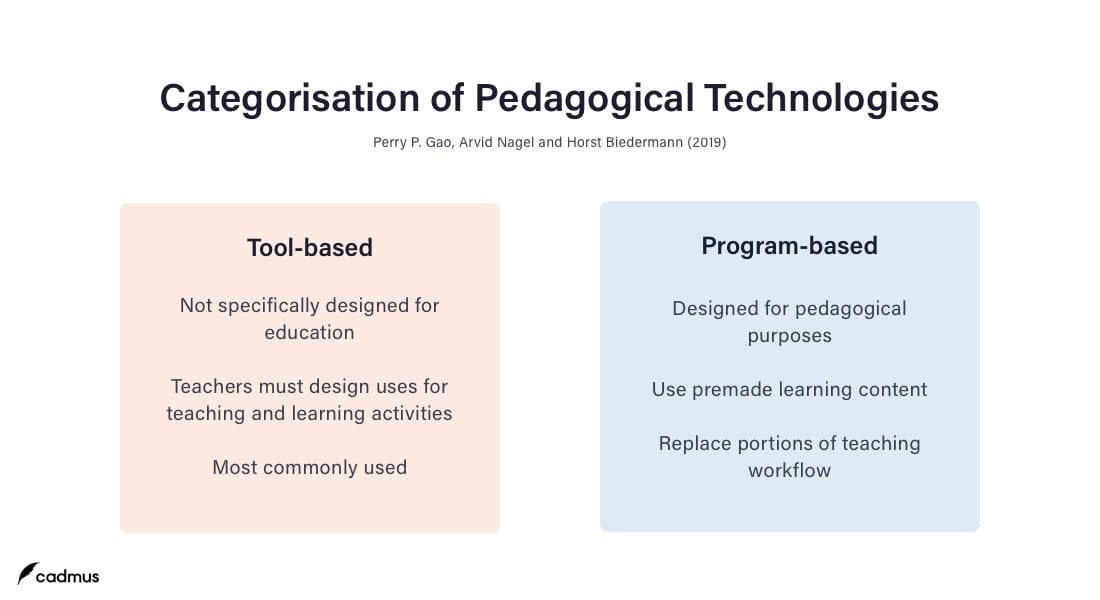 An overview of the differences between tool-based and program-based technologies.
Tool-based technologies were never explicitly designed for learning. Over the years, they have been co-opted by teachers to assist with parts of their workflow. Examples include Microsoft Word or PowerPoint, which are widely used by teachers to create learning materials or students to write submissions. However, the tools themselves do not help to improve teaching or learning in any way.
Platforms like ProctorU or similar proctoring tools can also be classed as tool-based technologies, replacing the in-person invigilation workflow without offering any learning benefits. These tools provide administrative benefits, but little else when it comes to teaching and learning.
On the other hand, program-based technologies are specifically designed for pedagogical purposes. They use pre-made learning content and focus on replacing considerable portions of a teacher's work, such as instruction delivery, feedback, or academic skills development. By focussing on the teaching and learning journey, these technologies guide teachers and students towards better outcomes.
Take applications like Cadmus or Duolingo — two great examples of program-based technologies. Although used in different contexts, at their core, they combine learning content and educative nudges to extend teaching beyond in-class interactions.
The right tool for the job
Over the last two years, almost all new technologies used by universities were tool-based (video conferencing, proctoring, content delivery solutions, and more). While this approach provided convenience during a stressful time, it's important to understand the long term impacts of adopting tool-based technologies at scale.
Without any pedagogical support in a product, pressure is placed on teachers to innovate and generate desired outcomes. This can be a significant challenge for time-poor educators. And with the success of wide-scale adoption entirely dependent on how teachers engage, this creates an increasing need for access to professional support. Paired with tight budgets, this can put successful tool adoption at risk.
In contrast, investing in program-based technologies, especially those co-designed with educational researchers and institutions, is more economically efficient. These tools offer a compelling path forward, providing students with more autonomy in the learning process and teachers more capacity to help students with higher-level learning. By taking the pressure off individual teachers and support staff, the right program-based tool can help universities scale up quality education and create supportive online learning spaces.
Category
Leadership
More News
Load more


AI
Leadership
Why “AI-proofing” assessments misses the point—and what to design for instead
This article challenges the idea of “AI-proofing” assessment, arguing that restriction and detection strategies fail to address the real issue: assessment designs that no longer produce reliable evidence of student capability. Nick Bareham explores how universities can instead design assessments that make thinking, judgment, communication, and applied understanding visible—the very capabilities employers are increasingly demanding in an AI-enabled world.
Nick Bareham, Chief Growth Officer, Cadmus
2026-06-09


AI
Leadership
Why AI demands a redesign of assessment—not just a policy response
This article argues that AI has exposed a deeper structural weakness in higher education assessment: the reliance on outputs as proxies for genuine learning and capability. Brigitte Elliott explores why policy and detection tools alone cannot solve this challenge, and why institutions must redesign assessment to make student thinking, reasoning, and understanding visible.
Brigitte Elliott, Co-CEO, Cadmus
2026-05-26



AI
Leadership
The degree has always been a signal. AI is changing how we verify it.
This piece explores how AI has fundamentally disrupted the university degree as a trusted signal of capability, decoupling assessment outputs from genuine student understanding. Herk Kailis argues that institutions must move beyond AI detection tools, toward approaches that require students to demonstrate authentic understanding in real time.
Herk Kailis, Founder & Co-CEO, Cadmus
2026-05-11