News
Identifying and mitigating risks of AI in authentic assessment practices



Share with colleagues
Download the full Case Study
Take an in-depth look at how educators have used Cadmus to better deliver assessments.
As the higher education sector finds ways to harness and embrace the recent release of ChatGPT and other artificial intelligence platforms which present immediate risk of academic misconduct in assessment creation, specifically contract cheating, Cadmus will continue to support university partners through this with long-established and sophisticated academic integrity capabilities.
Cadmus is the world's first authentic assessment for learning platform, purposefully built with sophisticated learner analytics to support and detect the authenticity of students' work. Developed in alignment with the Higher Education Standards Framework, Cadmus has the existing capabilities to identify, support and provide academic integrity breach data to improve practices in teaching and learning specifically aligned to students' use of ChatGPT or other artificial intelligence platforms.
While this provides an immediate solution to support higher education providers in responding to concerns of academic misconduct, Cadmus' rich platform capabilities solve the core factors attributed to contract cheating by enabling high-quality, authentic assessment design to be executed at scale across every academic discipline.
How Cadmus reduces students’ reliance on AI
The Cadmus platform has been built on rich pedagogical principles to support students throughout the learning and assessment process, taking a balanced approach to academic integrity through education, prevention, and detection.
As identified by Bretag and Harper et al. (2017), students who engage in contract cheating report being significantly less satisfied with four main teaching and learning factors, including access to academic staff for assistance with assessments, understanding of assessment expectations, explanation of academic integrity requirements, and feedback on assignments.
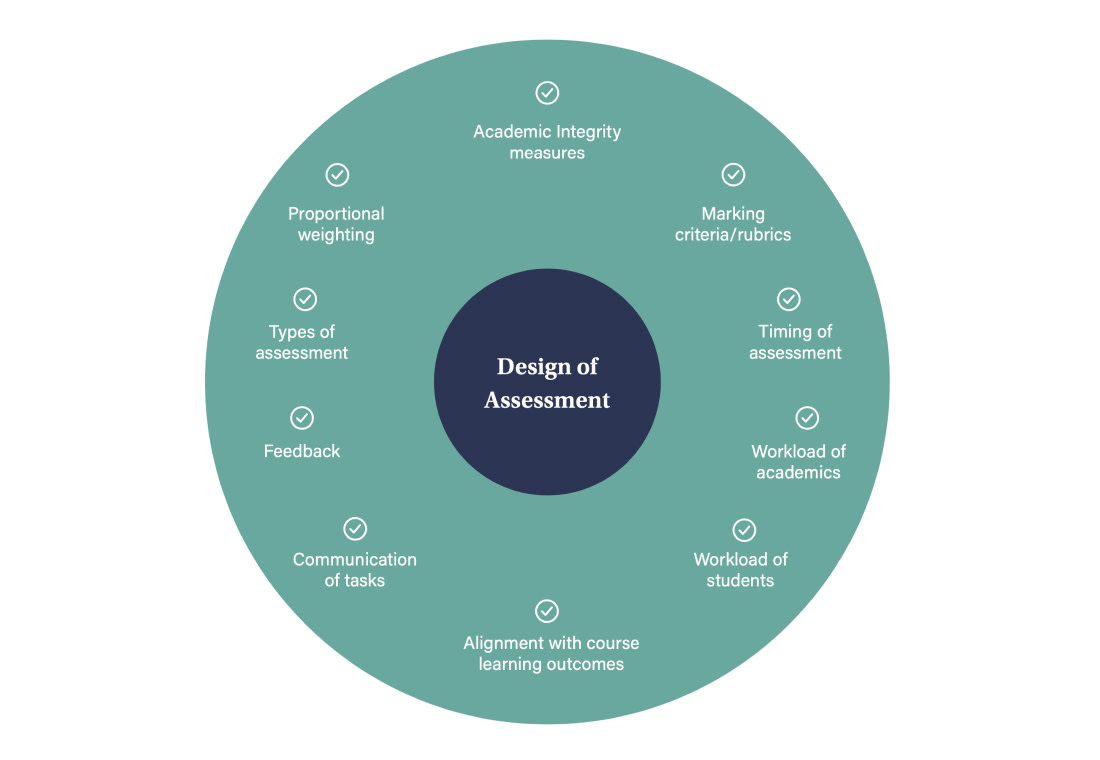
To address these factors and reduce opportunities for academic misconduct and reliance on AI platforms such as ChatGPT, the Cadmus student workspace incorporates the key elements of best practice assessment design. Within Cadmus, students have access to a number of support features including point-of-need academic integrity guidance, academic skills support, referencing guides, scaffolded assessment checklists and real-time educator feedback. Through these supportive features, Cadmus removes learning participation barriers, enabling students of varying backgrounds and locations to clearly understand their assessment requirements, foster original thinking and develop authentic work that leads to greater assessment outcomes.
Enabling educators to detect the use of AI in assessments
Cadmus provides educators with access to real-time analytics, which monitor the process around students’ development of their assessment rather than trying to catch AI-generated content at the point of submission. Educators can clearly identify how many hours a student has spent writing their assessment in Cadmus, if the work was copied and pasted or transcribed into Cadmus, and the source from which any pasted work originated.
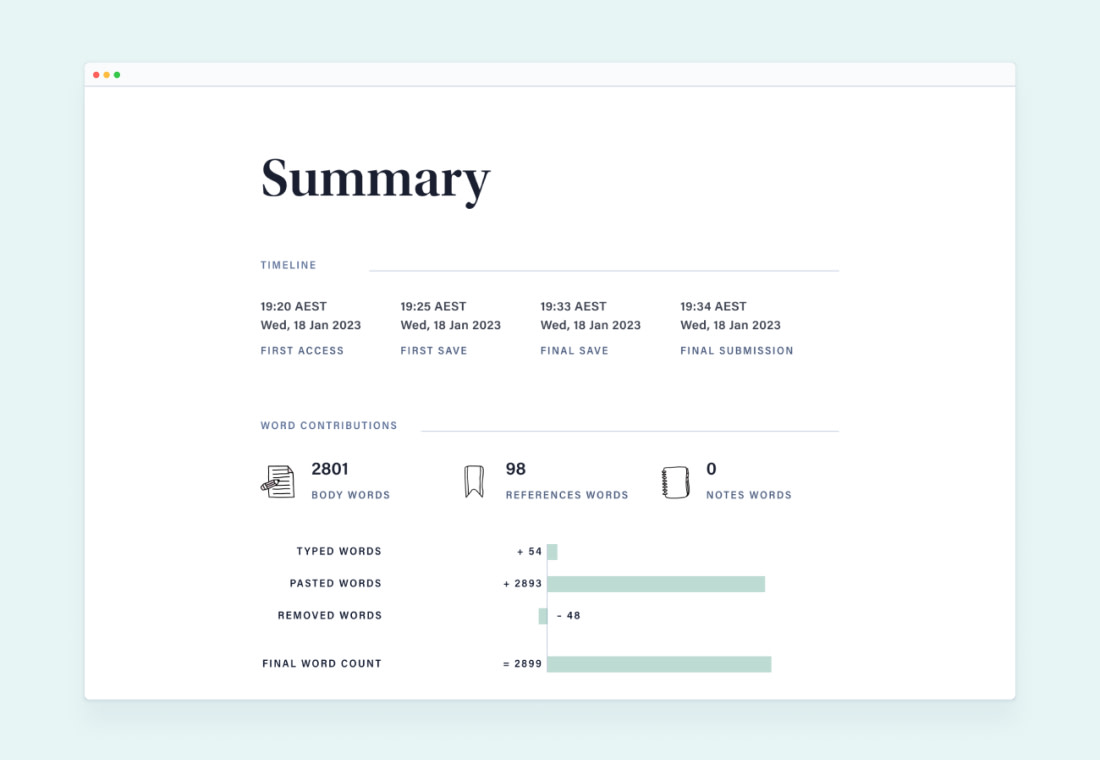
Cadmus is also able to analyse assessment construction techniques that are uniquely attributed to students using ChatGPT or AI-generated content. One example of this includes identifying students who paste their assessment content into the Cadmus workspace and make slight edits in an attempt to create an authentic submission, before submitting through Cadmus and, subsequently, Turnitin.
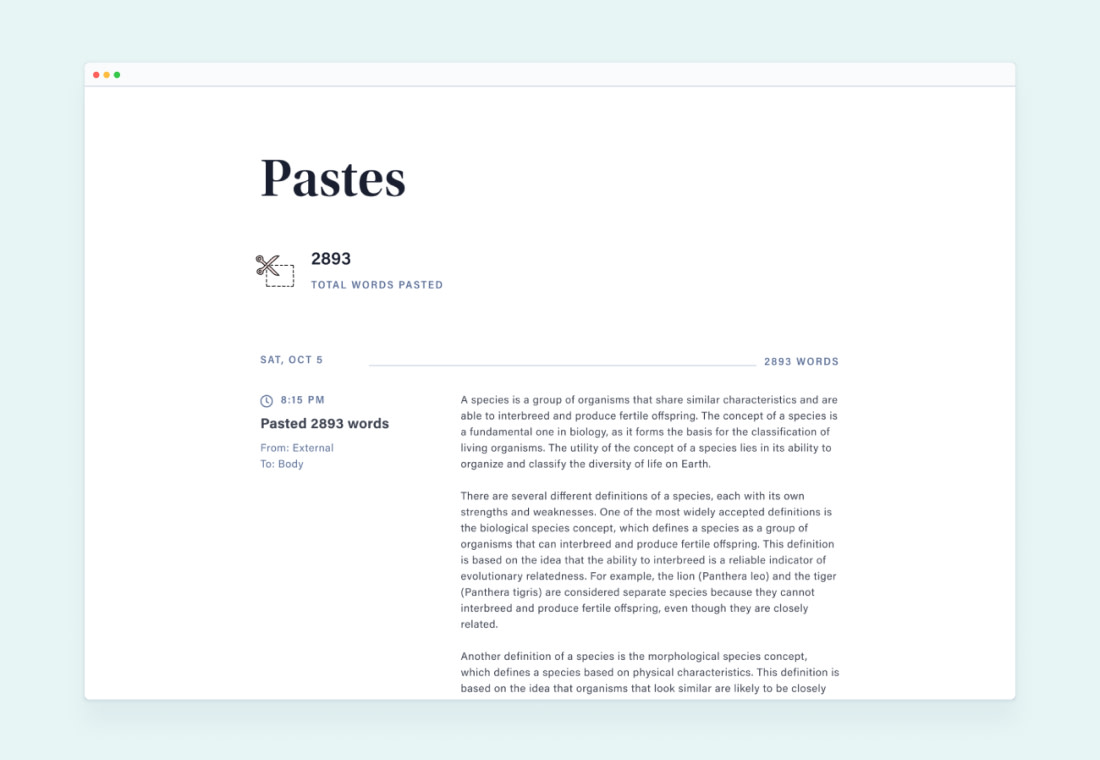
Through utilising Cadmus analytics, if educators believe a student or students are at risk of academic misconduct through the misuse of ChatGPT or other artificial intelligence platforms, end-to-end reconstruction reports are available to identify this behaviour at a unit, faculty and university level.
Supporting Cadmus university partners with existing capabilities
Continuing to support our university network as they navigate how best to purposefully incorporate artificial intelligence into student learning and assessment, David Israel, Director of Educational Innovation and Commercial Development at the University of Melbourne, said:
“The institution will continue to partner with Cadmus to improve assessment methodology and combat contract cheating. Cadmus is now a market-leading solution that helps academics to develop and deliver authentic assessment and minimise academic integrity risks by addressing the problem ‘at the source’—that is, during the student’s engagement in their assessment task. Because students must develop their assessment responses within the Cadmus environment, it provides a high level of certainty over the authenticity of the work presented for grading.”
Category
Academic Integrity
Student Success
Leadership
More News
Load more


AI
Leadership
Why “AI-proofing” assessments misses the point—and what to design for instead
This article challenges the idea of “AI-proofing” assessment, arguing that restriction and detection strategies fail to address the real issue: assessment designs that no longer produce reliable evidence of student capability. Nick Bareham explores how universities can instead design assessments that make thinking, judgment, communication, and applied understanding visible—the very capabilities employers are increasingly demanding in an AI-enabled world.
Nick Bareham, Chief Growth Officer, Cadmus
2026-06-09


AI
Leadership
Why AI demands a redesign of assessment—not just a policy response
This article argues that AI has exposed a deeper structural weakness in higher education assessment: the reliance on outputs as proxies for genuine learning and capability. Brigitte Elliott explores why policy and detection tools alone cannot solve this challenge, and why institutions must redesign assessment to make student thinking, reasoning, and understanding visible.
Brigitte Elliott, Co-CEO, Cadmus
2026-05-26



AI
Leadership
The degree has always been a signal. AI is changing how we verify it.
This piece explores how AI has fundamentally disrupted the university degree as a trusted signal of capability, decoupling assessment outputs from genuine student understanding. Herk Kailis argues that institutions must move beyond AI detection tools, toward approaches that require students to demonstrate authentic understanding in real time.
Herk Kailis, Founder & Co-CEO, Cadmus
2026-05-11