News
Using Cadmus to support students affected by COVID-19



Share with colleagues
Download the full Case Study
Take an in-depth look at how educators have used Cadmus to better deliver assessments.
With the Coronavirus affecting Semester 1 preparations (and possibly beyond), we wanted to provide some examples of how Cadmus is being used to support online teaching efforts. Here are two simple ways Cadmus can be used to help you rapidly move your assessments online to ensure accessibility, improve support, and maintain inclusivity for students as the continue their studies online.
Use a Cadmus Template to improve instructional scaffolding
Transferring your assessment into Cadmus using a template is the simplest and easiest way to adapt your task to support students affected by the Coronavirus. By moving your task into a Cadmus Template, you will improve the instructional scaffolding delivered to students, and receive learning analytics on student engagement.
For students who can no longer take advantage of face-to-face help, this additional scaffolding will guide students through the process of completing a task, helping to bridge the gap and create a more positive assessment experience. There are a range of templates available, including Essays, Annotated Bibliographies, Reflective Journals, Case Studies, and more. Learn more about Cadmus Templates.
Set up online activities to supplement tutorials
If your tutorials involve written exercises and in-class discussions, you can transfer these activities into a series of online assignments with Cadmus. Here’s an example:
Steve runs the subject Accounting Information: Risks & Controls with 155 students, some of whom are affected by the COVID-19 travel restrictions. Typically, students complete written activities and participate in discussions during their tutorials. This helps Steve know that his students are continuously engaging. In order to re-create this experience for students in China, Steve converts these tasks into a series of Cadmus Assignments. Steve does this alongside a discussion board and video resources he has created for affected students.
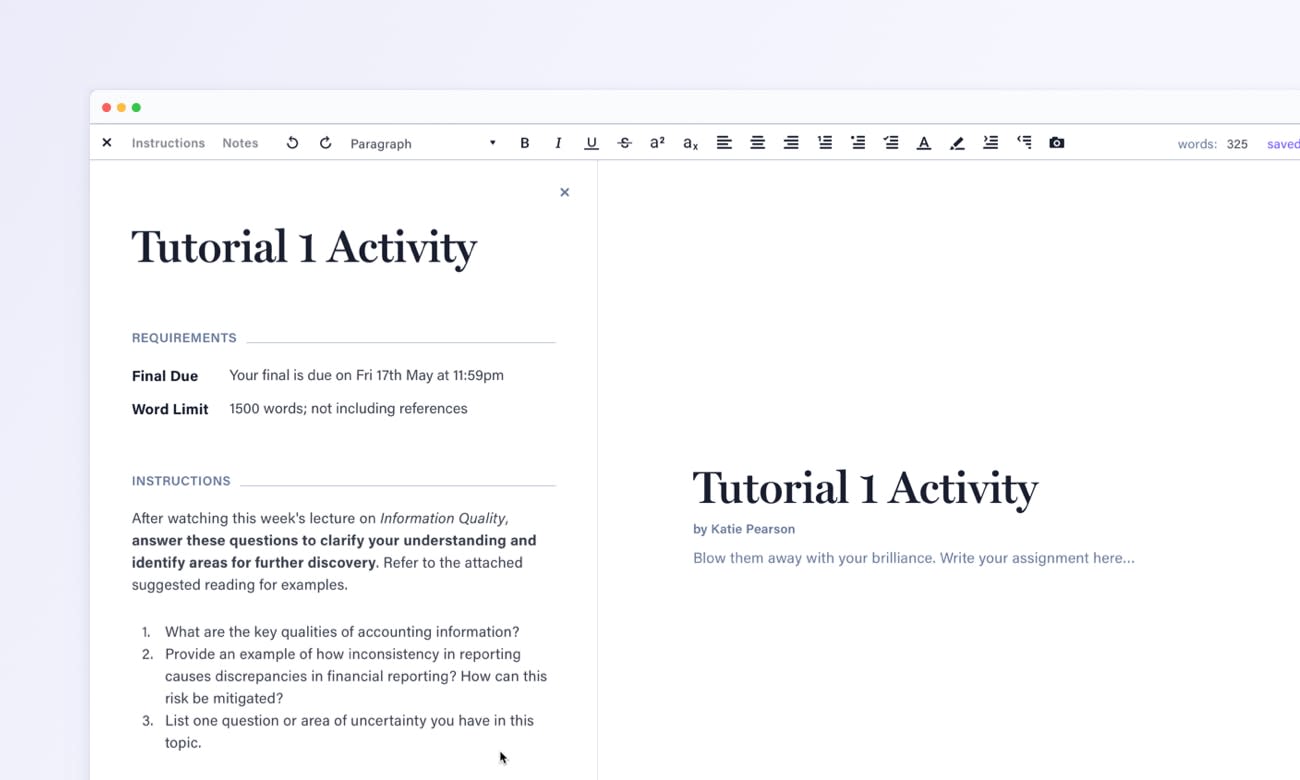
Here’s how he structures his assessment with Cadmus:
-
Steve sets up a Cadmus Assignment in the LMS for students to complete.
-
Students access the task and additional resources in Cadmus, before answering the questions Steve has set out in the instructions.
-
Using Cadmus Learning Analytics, Steve can see how his class is progressing through the task and how students are engaging with resources in Cadmus.
-
His students submit their written responses through Cadmus.
-
Steve reviews a selection of submissions and shares group feedback, along with discussion points from the in-class tutorial.
-
Students refer to the feedback, helping them refine their understanding and continue engaging with the content.
Category
Assessment Design
More News
Load more


AI
Leadership
Why “AI-proofing” assessments misses the point—and what to design for instead
This article challenges the idea of “AI-proofing” assessment, arguing that restriction and detection strategies fail to address the real issue: assessment designs that no longer produce reliable evidence of student capability. Nick Bareham explores how universities can instead design assessments that make thinking, judgment, communication, and applied understanding visible—the very capabilities employers are increasingly demanding in an AI-enabled world.
Nick Bareham, Chief Growth Officer, Cadmus
2026-06-09


AI
Leadership
Why AI demands a redesign of assessment—not just a policy response
This article argues that AI has exposed a deeper structural weakness in higher education assessment: the reliance on outputs as proxies for genuine learning and capability. Brigitte Elliott explores why policy and detection tools alone cannot solve this challenge, and why institutions must redesign assessment to make student thinking, reasoning, and understanding visible.
Brigitte Elliott, Co-CEO, Cadmus
2026-05-26



AI
Leadership
The degree has always been a signal. AI is changing how we verify it.
This piece explores how AI has fundamentally disrupted the university degree as a trusted signal of capability, decoupling assessment outputs from genuine student understanding. Herk Kailis argues that institutions must move beyond AI detection tools, toward approaches that require students to demonstrate authentic understanding in real time.
Herk Kailis, Founder & Co-CEO, Cadmus
2026-05-11